EGU2026
University of Münster
Ruhr-University Bochum
University of Hamburg
Ruhr-University Bochum
University of Hamburg
University of Münster
2026-05-06
Area of Applicability (Meyer and Pebesma 2021) defines the domain in which a model is trusted to operate within estimated performance measures
Our hypothesis is that:
Latent representations learned by deep models provide a computationally efficient and reliable basis for defining an Area of Applicability for Earth Observation models.
We are analyzing the question:
Under which conditions do distance-based confidence scores in the latent space of a deep model favourably delinate the Area of Applicability?
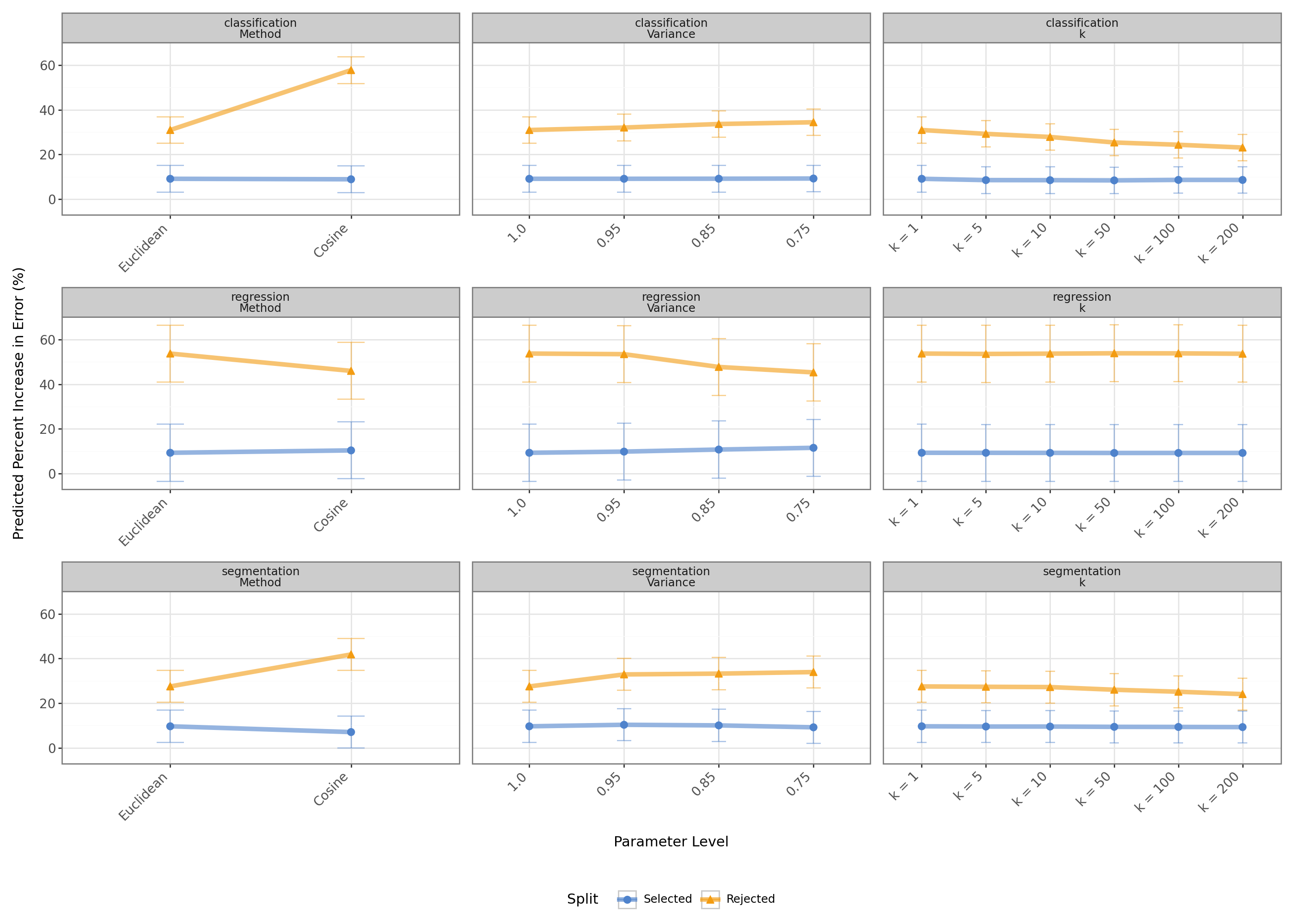
Average effects of analysed parameters on preservation and separation for classification.


In the real world, models might be used for inference on samples which are outside of their domain of application.
Example of overconfident predictions for OOD samples (Hou 2023.)
Neural network-based classifiers may silently fail when the test data distribution differs from the training data. For critical tasks such as medical diagnosis or autonomous driving, it is thus essential to detect incorrect predictions based on an indication of whether the classifier is likely to fail.
Jaeger et al. (2023)
We are aiming to define a Selective Inference Model for deep learning models in Earth Observation:
\[ h(x) = \begin{cases} \varnothing, \; \text{if} \; g(x) = 1, \\ f(x), \; \text{if} \; g(x) = 0. \end{cases} \tag{1}\]
We evaluate the candidates based on two criteria:

| Country | Train | Validation | Test | Total | Tiles |
|---|---|---|---|---|---|
| Austria | 24,972 | 10,649 | 8,176 | 43,797 | 16 |
| Belgium | 7,837 | 3,217 | 142 | 11,196 | 6 |
| Finland | 74,293 | 40,132 | 40,802 | 155,227 | 44 |
| Ireland | 22,482 | 12,687 | 13,157 | 48,326 | 9 |
| Kosovo | 849 | 487 | 280 | 1,616 | 1 |
| Lithuania | 23,170 | 12,128 | 13,067 | 48,365 | 15 |
| Luxembourg | 1,888 | 1,131 | 441 | 3,460 | 4 |
| Portugal | 43,721 | 22,862 | 23,209 | 89,792 | 12 |
| Serbia | 36,967 | 17,906 | 18,512 | 73,385 | 17 |
| Switzerland | 1,692 | 1,143 | 2,039 | 4,874 | 1 |
| Total | 237,871 | 122,342 | 119,825 | 480,038 | 125 |
\[ Y_i = X_i^\top \beta + b_{c(i)} + \varepsilon_i \tag{2}\]
with:
Average rejected percentage for classification (C) by country and distance metric. Error bars represent the range over all configurations.
Average increase in error for classification (C) by country and selection. Error bars represent the range over all configurations.

| Parameter | Coef. | Std.Err. | \(P>|z|\) | Sig. |
|---|---|---|---|---|
| Intercept (Euclidean, Selected) | 9.123 | 3.032 | 0.0026 | ** |
| Rejected | 21.839 | 1.034 | 0 | *** |
| Method: Cosine | -0.213 | 0.463 | 0.6454 | |
| Variance: 0.95 | 0.007 | 0.654 | 0.9913 | |
| Variance: 0.85 | 0.041 | 0.654 | 0.9496 | |
| Variance: 0.75 | 0.128 | 0.654 | 0.8443 | |
| \(k = 5\) | -0.589 | 0.801 | 0.462 | |
| \(k = 10\) | -0.62 | 0.801 | 0.4391 | |
| \(k = 50\) | -0.711 | 0.801 | 0.3752 | |
| \(k = 100\) | -0.496 | 0.801 | 0.5358 | |
| \(k = 200\) | -0.512 | 0.801 | 0.5225 | |
| Rejected x Method: Cosine | 27.024 | 0.654 | 0 | *** |
| Rejected x Variance: 0.95 | 1.088 | 0.925 | 0.2396 | |
| Rejected x Variance: 0.85 | 2.644 | 0.925 | 0.0043 | ** |
| Rejected x Variance: 0.75 | 3.343 | 0.925 | 0.0003 | *** |
| Rejected x \(k = 5\) | -1.137 | 1.133 | 0.3155 | |
| Rejected x \(k = 10\) | -2.493 | 1.133 | 0.0278 | * |
| Rejected x \(k = 50\) | -4.877 | 1.133 | 0 | *** |
| Rejected x \(k = 100\) | -6.109 | 1.133 | 0 | *** |
| Rejected x \(k = 200\) | -7.342 | 1.133 | 0 | *** |


Given a trained model \(f: \mathcal X \mapsto \mathcal Y\) and a novelty score function \(s: \mathbb{R^d} \mapsto \mathbb{R^1}\).
We induce a decision function \(g\):
\[ g_{\lambda}(x|s) = \mathbb{1}{ \{ s(x) > \lambda \} }. \tag{3}\]
Traditionally, we evaluate if \(g\) is successful in detecting samples from another distribution (OOD detection): \[ g(x) = \begin{cases} OOD, \; \text{if} \; g(x) = 1, \\ ID, \; \text{if} \; g(x) = 0, \end{cases} \tag{4}\]
However, in many real-world applications, we are interested in accepting samples were the model is expected to perform well and rejecting those where it is expected to perform poorly:
\[ h(x) = \begin{cases} \varnothing, \; \text{if} \; g(x) = 1, \\ f(x), \; \text{if} \; g(x) = 0. \end{cases} \tag{5}\]
\[ \begin{aligned} Y_i &= \beta_0 + \beta_1\,\text{Rejected}_i + \beta_2\,\text{Method}_i + \beta_3\,\text{Variance}_i \\ &\quad + \beta_4\,K_i + \beta_5\,(\text{Rejected}_i \times \text{Method}_i) \\ &\quad + \beta_6\,(\text{Rejected}_i \times \text{Variance}_i) + \beta_7\,(\text{Rejected}_i \times K_i) + b_{c(i)} + \varepsilon_i \end{aligned} \]

Preservation
Separation
Average rejected percentage for classification (C) by country and distance metric. Error bars represent the range over all configurations.
Average increase in error for classification (C) by country and selection. Error bars represent the range over all configurations.
In-distribution error versus out-of-distribution error (each dot represents the average over a country dataset).
| Parameter | Coef. | Std.Err. | \(P>|z|\) | Sig. |
|---|---|---|---|---|
| Intercept (Euclidean, Selected) | 9.123 | 3.032 | 0.0026 | ** |
| Rejected | 21.839 | 1.034 | 0 | *** |
| Method: Cosine | -0.213 | 0.463 | 0.6454 | |
| Variance: 0.95 | 0.007 | 0.654 | 0.9913 | |
| Variance: 0.85 | 0.041 | 0.654 | 0.9496 | |
| Variance: 0.75 | 0.128 | 0.654 | 0.8443 | |
| \(k = 5\) | -0.589 | 0.801 | 0.462 | |
| \(k = 10\) | -0.62 | 0.801 | 0.4391 | |
| \(k = 50\) | -0.711 | 0.801 | 0.3752 | |
| \(k = 100\) | -0.496 | 0.801 | 0.5358 | |
| \(k = 200\) | -0.512 | 0.801 | 0.5225 | |
| Rejected x Method: Cosine | 27.024 | 0.654 | 0 | *** |
| Rejected x Variance: 0.95 | 1.088 | 0.925 | 0.2396 | |
| Rejected x Variance: 0.85 | 2.644 | 0.925 | 0.0043 | ** |
| Rejected x Variance: 0.75 | 3.343 | 0.925 | 0.0003 | *** |
| Rejected x \(k = 5\) | -1.137 | 1.133 | 0.3155 | |
| Rejected x \(k = 10\) | -2.493 | 1.133 | 0.0278 | * |
| Rejected x \(k = 50\) | -4.877 | 1.133 | 0 | *** |
| Rejected x \(k = 100\) | -6.109 | 1.133 | 0 | *** |
| Rejected x \(k = 200\) | -7.342 | 1.133 | 0 | *** |


In-distribution error versus out-of-distribution error (each dot represents the average over a country dataset).
| Parameter | Coef. | Std.Err. | \(P>|z|\) | Sig. |
|---|---|---|---|---|
| Intercept (Euclidean, Selected) | 9.28 | 6.501 | 0.1534 | |
| Rejected | 44.42 | 0.853 | 0 | *** |
| Method: Cosine | 1.073 | 0.382 | 0.0049 | ** |
| Variance: 0.95 | 0.529 | 0.54 | 0.3273 | |
| Variance: 0.85 | 1.454 | 0.54 | 0.007 | ** |
| Variance: 0.75 | 2.229 | 0.54 | 0 | *** |
| \(k = 5\) | -0.013 | 0.661 | 0.9841 | |
| \(k = 10\) | -0.037 | 0.661 | 0.955 | |
| \(k = 50\) | -0.079 | 0.661 | 0.9043 | |
| \(k = 100\) | -0.075 | 0.661 | 0.9095 | |
| \(k = 200\) | -0.063 | 0.661 | 0.9239 | |
| Rejected x Method: Cosine | -8.836 | 0.54 | 0 | *** |
| Rejected x Variance: 0.95 | -0.8 | 0.763 | 0.2943 | |
| Rejected x Variance: 0.85 | -7.446 | 0.763 | 0 | *** |
| Rejected x Variance: 0.75 | -10.667 | 0.763 | 0 | *** |
| Rejected x \(k = 5\) | -0.156 | 0.935 | 0.8672 | |
| Rejected x \(k = 10\) | -0 | 0.935 | 0.9998 | |
| Rejected x \(k = 50\) | 0.205 | 0.935 | 0.8266 | |
| Rejected x \(k = 100\) | 0.165 | 0.935 | 0.8602 | |
| Rejected x \(k = 200\) | -0.026 | 0.935 | 0.9781 |


In-distribution error versus out-of-distribution error (each dot represents the average over a country dataset).
| Parameter | Coef. | Std.Err. | \(P>|z|\) | Sig. |
|---|---|---|---|---|
| Intercept (Euclidean, Selected) | 9.657 | 3.651 | 0.0082 | ** |
| Rejected | 17.845 | 0.836 | 0 | *** |
| Method: Cosine | -2.587 | 0.374 | 0 | *** |
| Variance: 0.95 | 0.67 | 0.529 | 0.2047 | |
| Variance: 0.85 | 0.406 | 0.529 | 0.4429 | |
| Variance: 0.75 | -0.457 | 0.529 | 0.3867 | |
| \(k = 5\) | -0.104 | 0.647 | 0.8722 | |
| \(k = 10\) | -0.118 | 0.647 | 0.8559 | |
| \(k = 50\) | -0.247 | 0.647 | 0.7029 | |
| \(k = 100\) | -0.294 | 0.647 | 0.6502 | |
| \(k = 200\) | -0.361 | 0.647 | 0.5767 | |
| Rejected x Method: Cosine | 16.905 | 0.529 | 0 | *** |
| Rejected x Variance: 0.95 | 4.702 | 0.747 | 0 | *** |
| Rejected x Variance: 0.85 | 5.324 | 0.747 | 0 | *** |
| Rejected x Variance: 0.75 | 6.887 | 0.747 | 0 | *** |
| Rejected x \(k = 5\) | -0.057 | 0.915 | 0.9505 | |
| Rejected x \(k = 10\) | -0.172 | 0.915 | 0.8506 | |
| Rejected x \(k = 50\) | -1.235 | 0.915 | 0.1774 | |
| Rejected x \(k = 100\) | -2.083 | 0.915 | 0.0229 | * |
| Rejected x \(k = 200\) | -3.082 | 0.915 | 0.0008 | *** |